
Work-from-Home Benefits of Owning a Spacious 3BHK Apartment

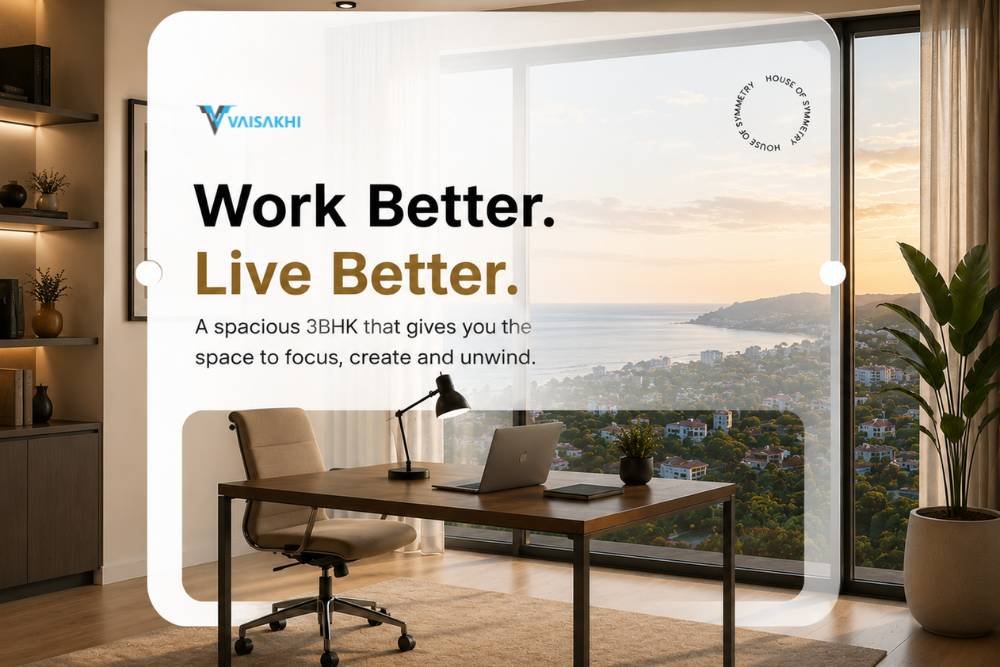
Hybrid work didn’t turn out to be the temporary arrangement many expected in 2020. Six years on, it’s simply how a large share of India’s workforce operates. And it’s reshaped a question that used to be simple “how many bedrooms do I need?” into something more layered: how much of my home actually needs to double as my office?
For anyone currently house-hunting, this question has real financial and lifestyle weight. A spacious 3BHK apartment has quietly become one of the most practical choices for professionals balancing office days with work-from-home days — and the reasons go well beyond just “more space”.
Hybrid Work Is Now India’s Default, Not the Exception
The data on this is fairly unambiguous. Roughly 70% of tech organisations in India have adopted hybrid work models, according to NASSCOM figures, with adoption steadily climbing in other sectors as digital infrastructure matures. Even more telling: 88% of Indian workers say flexible or remote work options are key to their overall job satisfaction and loyalty — one of the highest figures globally, ahead of markets like Japan and Singapore.
Globally, hybrid arrangements have settled into a fairly consistent pattern most organisations now expect around three days in-office and the rest remote or flexible, often called the “3-2” model. That means a significant portion of any given work week is still spent working from home, and the way your living space accommodates that has a direct impact on your productivity, focus, and day-to-day comfort.
This is precisely why buyers are re-evaluating what “enough space” means. A 2BHK that worked fine for a couple with one office worker suddenly feels tight when both partners need private, quiet space to take calls on overlapping schedules.
Why a 3BHK Specifically Solves the Hybrid Work Problem
A Genuine Dedicated Workspace, Not a Corner of the Bedroom
The single biggest complaint about working from home in a 1 or 2BHK is the lack of separation between “home” and “work”. A third room changes this equation entirely. It gives you a space that can function as a proper home office — with a door you can close, a desk that stays set up, and a background that looks professional on video calls — instead of a laptop balanced on a dining table that has to be cleared every evening.
This isn’t a minor comfort. Architects and building trends in 2026 increasingly point to WFH-specific design considerations: dedicated work nooks, soundproofing, and lighting suited to concentration rather than just ambience. A 3BHK gives you the physical room to actually implement this rather than trying to retrofit focus into a shared living space.
Real Acoustic and Visual Privacy for Calls and Meetings
When two people in the same household are both on video calls at the same time, an open floor plan becomes a liability. A dedicated third room with a closable door solves the most common friction point of hybrid work — background noise, interruptions, and the awkwardness of professional calls happening within earshot of family life.
Room to Separate “Deep Work” From “Rest”
Behavioural research on remote work consistently highlights one thing: workers who can physically separate their workspace from their relaxation space report better focus and better ability to switch off at the end of the day. A spare bedroom used purely as an office, one you can walk away from and shut the door on, supports that boundary in a way an open studio or shared living room simply cannot.
Flexibility for Life Changes
A third room isn’t only a home office. It’s flexible enough to become a nursery, a guest room, a study for children, or space for ageing parents moving in all without needing to relocate. For hybrid workers specifically, this flexibility matters because work patterns shift: a fully remote job today might become a hybrid one next year, or a side business might need a proper operating base. Buying a 3BHK is, in effect, buying yourself room to adapt without the cost and disruption of moving again.
Better Resale and Rental Demand
From a purely practical investment standpoint, 3BHK units in growth corridors are seeing strong demand precisely because hybrid work has made the “extra room” a genuine requirement rather than a luxury. Properties that can comfortably support a home office command better interest from both future buyers and tenants, particularly professionals and families relocating for IT and corporate jobs – a growing segment in cities like Visakhapatnam, given ongoing infrastructure and employment growth in the region.
What to Actually Look for in a “Work-from-Home Ready” 3BHK
Not every 3BHK is equally suited to hybrid work. When you’re evaluating options, look beyond the basic room count:
Room placement matters. A third bedroom positioned away from the main living and kitchen area – ideally near an external wall for natural light – makes a far better office than one sandwiched between high-traffic zones.
Connectivity infrastructure. Ask about the building’s internet backbone and whether high-speed broadband and backup connectivity are already provisioned. A home office is only as good as its internet connection.
Common-area alternatives. Many premium projects now include co-working lounges, private booths, or business centres within the community itself, useful for days you want a change of scenery without the commute or for calls that need a more formal setting than your apartment.
Power backup. Reliable backup power for at least basic connectivity and lighting is non-negotiable for anyone attending video calls or meeting deadlines from home.
Soundproofing and window quality. Especially relevant for apartments facing busy roads good window insulation is the difference between clean audio on a call and constant background noise.
What the Research Says About Productivity and Space
It’s worth grounding this in more than intuition. One of the most rigorously conducted studies on hybrid work, a randomised controlled trial involving over 1,600 professional employees, led by Stanford economist Nicholas Bloom, found that employees working from home two days a week were just as productive and just as likely to be promoted as fully office-based peers. Separately, broader surveys show that around 90% of hybrid employees report equal or higher productivity compared to full-time office work.
What these findings share is an underlying assumption that often goes unstated: employees can only sustain that productivity if their home environment actually supports focused work. A well-defined workspace isn’t a nice-to-have sitting alongside these statistics — it’s part of what makes the numbers possible in the first place. Somebody attending back-to-back calls from a kitchen table, competing with household noise and interruptions, is not the same worker being measured in a controlled study with an implicit assumption of a functional home office setup.
This is also why attendance patterns matter for space planning. Data on hybrid work shows that in-office attendance consistently peaks midweek Tuesday and Wednesday while Mondays and Fridays are quieter. In practice, this means most hybrid professionals are working from home for a meaningful chunk of every single week, not occasionally. A workspace used two or three days a week, every week, isn’t a temporary setup; it’s a permanent fixture of how you’ll live in your home, which is exactly the case for treating it as a genuine room rather than an improvised corner.
Beyond the Individual: What This Means for Families
The case for a 3BHK becomes even stronger in households with more than one working adult or with children attending online classes or needing a quiet study space. Two adults on overlapping video calls in an open 2BHK layout is a recipe for constant scheduling friction — whose call takes priority in the living room, who retreats to the bedroom, and whose meeting gets interrupted by a delivery at the door. A dedicated third room removes this daily negotiation entirely, letting each person’s work rhythm operate independently.
For families with school-age children, the same room can flex between parent office hours and children’s study time, particularly with schools increasingly incorporating some digital or hybrid learning elements. This dual-use flexibility is part of why 3BHK demand has held up even among buyers who don’t work fully remote, the room’s utility extends well beyond one person’s job.
Making the Financial Case
It’s worth acknowledging directly: a 3BHK costs more than a 2BHK, both in purchase price and monthly outgoings. But it’s useful to frame this against the alternative costs of not having adequate WFH space commercial co-working memberships, productivity loss from constant interruption, or the cost and disruption of upgrading to a larger home within a few years as work patterns and family needs evolve. For most hybrid professionals, the additional room pays for itself in comfort and functionality far faster than it might appear on paper.
Vaisakhi Developers: Designing for How You Actually Work Now
This is exactly the shift Vaisakhi Developers has built into its residential planning. Backed by over 22 years of experience, 17+ completed projects, and more than 4,500 happy customers, Vaisakhi Developers under the leadership of Sri B. Vidya Sagar, Sri B. Ramakrishna, and Smt. T. Geeta Nandini designs homes meant to hold up to real, everyday demands, not just showroom expectations.
Their ongoing project, Vaisakhi Sundar Skylounge in Madhurawada, is built around exactly this kind of flexible, spacious living:
- 578 well-proportioned 3 BHK residences spanning 1,845 to 2,445 sq. ft. genuinely large enough for a dedicated home office, not just a converted corner
- Andhra Pradesh’s first parametric architecture project, rising 30 floors with generous natural light across units
- A dedicated business lounge and home theatre among the 50+ amenities useful for calls, presentations, or a change of scenery without leaving the community
- In-unit provisions for internet connectivity in the drawing and living rooms, plus AC provisioning in every room for year-round comfort during work hours
- Round-the-clock security, BMS, and automated billing systems, so day-to-day life runs smoothly around a demanding hybrid schedule
- A Madhurawada address close to IT SEZs, GITAM University, and reputed hospitals practical for professionals balancing office days with home-based ones
- RERA-registered (P03280034023), with 30 floors, 578 units, and rooftop amenities 350 ft above ground
If a spacious, genuinely WFH-ready 3BHK is on your list, it’s worth exploring what Vaisakhi Sundar Skylounge has to offer in Madhurawada.