
Smart Home Features to Look for in New Apartments in Visakhapatnam

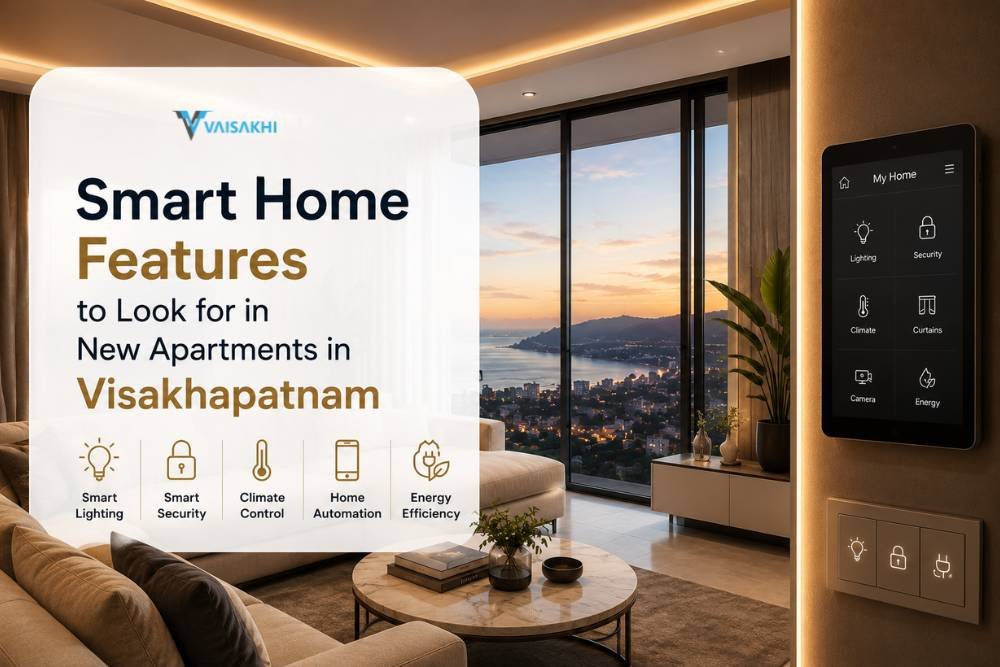
Walk into any new residential project launch in Visakhapatnam today and you’ll notice something has changed. Sales brochures no longer lead with just floor plans and Vastu compliance they lead with app-controlled lighting, video door phones, and integrated security systems. That’s not a marketing gimmick. It reflects a genuine shift in what homebuyers expect from a new apartment in 2026.
If you’re evaluating new apartments for sale in Visakhapatnam, understanding which smart features actually add value — and which are just buzzwords can help you make a far smarter purchase decision. This guide breaks down what to look for, why it matters, and how to separate genuine long-term value from short-lived novelty.
Why Smart Homes Have Become the Default, Not the Exception
Home automation in India has moved well past the experimental stage. Industry estimates project the Indian home automation market to grow from around USD 3.7 billion in 2025 to over USD 13 billion by 2034, expanding at a compound annual growth rate above 15%. That kind of growth doesn’t happen because of a passing trend — it happens because buyers are actively asking for these features, and developers are responding.
What used to be a luxury reserved for penthouses is now considered baseline in mid-to-premium housing. Buyers walking through 3 BHK apartments increasingly ask about voice control, smart lighting, and integrated security as a starting expectation, not an upgrade. For a coastal city like Visakhapatnam — where IT expansion, the upcoming Bhogapuram International Airport, and large corporate investments are drawing in a more tech-aware workforce — this shift is even more pronounced. Professionals relocating from Hyderabad, Bengaluru, or Chennai already expect the conveniences they’re used to, and developers in Vizag are catching up fast.
The Smart Home Features Actually Worth Prioritising
Not every “smart” label adds real value. Here’s what genuinely matters when you’re comparing new apartments.
1. Multi-Function Sensors for Lighting and Climate
Older smart lighting setups relied on simple motion sensors — lights turned on when they detected movement and off when they didn’t. The newer generation of sensors reads multiple conditions at once: occupancy, ambient light, temperature, and humidity. The practical benefit is lighting and air conditioning that responds to actual conditions in the room rather than blunt on/off triggers.
This matters financially too. Automated lighting, BLDC fans, and smart thermostats that adjust based on occupancy can cut household electricity consumption by roughly 20 to 35%. In a coastal city with Vizag’s humidity and cooling needs, that’s a meaningful saving over the life of your ownership.
2. Integrated Security Beyond a Single CCTV Camera
Security is the single feature buyers are least willing to compromise on. Look specifically for:
- Video door phones with mobile app access, so you can see who’s at your door even when you’re not home
- Smart locks with fingerprint, PIN, or app-based access instead of only a physical key
- Motion sensors at entry points with real-time alerts
- Integration between your apartment’s system and the building’s central intercom and lift-access controls, so security isn’t fragmented between unit and society level
This last point is often overlooked but genuinely important. A smart lock on your door means little if visitor management at the main gate is still a manual register. Ask developers specifically whether the in-apartment system talks to the building’s overall security infrastructure.
3. Energy Management with Solar Integration
With electricity costs rising and sustainability becoming a real purchase consideration, energy monitoring is no longer a niche feature. Systems that give you real-time consumption data how much power your AC, geyser, or lighting is using let you make informed decisions rather than guessing at your monthly bill. Projects that pair this with rooftop solar or common-area solar integration offer an additional layer of long-term savings, particularly relevant in a sun-rich city like Visakhapatnam.
4. Voice Control With Regional Language Support
Voice assistants have matured from handling single commands to managing complex, multi-step routines “good night” can now dim lights, lock doors, lower AC temperature, and arm security in one command. What’s changed recently is language support. Systems that support Telugu and other regional languages, not just English, make automation genuinely accessible to every member of the household, including elderly residents who might otherwise find English-only voice systems a barrier.
5. Systems Built In From Day One, Not Retrofitted
This is arguably the most important practical point for anyone comparing under-construction projects. Building automation into the wiring and infrastructure during construction is significantly more cost-effective than retrofitting it into a completed apartment. If you buy a unit with conduits, wiring, and panel capacity already designed for automation, adding or upgrading smart features later becomes a simple plug-in job rather than a wall-breaking renovation. This is a key differentiator between developers who treat “smart home” as a checkbox on a brochure versus those who’ve actually engineered it into the building.
6. Privacy-Conscious Design
An emerging and important consideration: many smart systems send usage data to cloud servers. If data privacy matters to you, ask whether the building’s systems support local processing options rather than routing everything through third-party clouds. It’s a detail most buyers don’t think to ask about, but one that increasingly matters as automation becomes more pervasive in daily life.
Smart Features Versus Smart Marketing: How to Tell the Difference
A helpful filter when you’re touring a sample flat: ask what happens if the internet goes down. Features that fail completely without connectivity (a lock you can’t open or an AC you can’t adjust) are more fragile than systems designed with local fallback controls. Similarly, ask whether the smart features are pre-installed and functional in the sample flat or simply described in the brochure. A genuine automation package will have panels, sensors, and app demonstrations you can actually test on-site.
It’s also worth asking about after-sales service and warranty terms specifically for the automation systems, separate from general apartment maintenance. Smart home components are electronic systems that will need servicing over a 10-15 year ownership horizon, and it matters who is responsible for that support.
What This Means for Buyers in Visakhapatnam
Visakhapatnam’s residential market is entering a phase where infrastructure-led growth the Bhogapuram airport, expanding IT and data centre investments, and improving connectivity across North Vizag is bringing in a more discerning, tech-familiar buyer base. Developers who integrate genuine automation, not just a smart-sounding label, are positioning their projects for stronger long-term relevance and resale value.
For homebuyers, the takeaway is simple: don’t just ask, “Does this apartment have smart features?” Ask which ones, how they’re integrated, whether they were designed in from the start, and how they’ll be supported for the years you’ll actually live there.
The Room-by-Room View: Where Smart Features Matter Most
It helps to think about automation room by room rather than as one abstract “smart home package”, since different spaces benefit from different priorities.
Living room. This is usually where automation is most visible: centralised lighting scenes, motorised curtains, and voice-controlled entertainment systems. It’s also the space where energy monitoring pays off most, since living rooms tend to have the highest concentration of lighting points and AC load in a typical apartment.
Kitchen. Increasingly, kitchens are becoming a genuine hub of connected technology: smart chimneys that adjust suction based on cooking activity, gas leak sensors that trigger automatic shutoffs, and app-based reminders for appliance maintenance. For safety-conscious buyers, a gas leak sensor is arguably one of the highest-value, lowest-cost automation features available and one worth specifically asking about.
Bedrooms. Automated lighting that responds to time of day, along with occupancy-based climate control, is where the “learning system” trend adds the most tangible daily comfort a home that dims lights in the evening and pre-cools a room before you walk in, without you touching a switch.
Entryway and security zone. This is non-negotiable territory. Video door phones, smart locks, and building-integrated access control belong here as standard, not optional add-ons.
Bathrooms. An emerging but growing trend is wellness-focused bathroom technology smart exhaust systems tied to humidity sensors to prevent mould, and water-leak detection under fittings that can prevent costly damage before it’s visible.
The Cost Question: What Should You Expect to Pay For
One legitimate buyer concern is cost both the upfront premium for a smart-enabled apartment and the long-term cost of maintaining these systems. The good news is that automation technology has become significantly more affordable in recent years; a comprehensive smart-lighting and climate package that may have cost a developer or homeowner a substantial sum five years ago can now be delivered for a fraction of that cost, with far greater reliability.
That said, buyers should still ask direct questions: Is the smart package included in the base price, or is it a paid upgrade? What’s covered under warranty, and for how long? Are the sensors and panels from established brands with accessible service networks in Visakhapatnam or from smaller vendors who may be harder to get support from a few years down the line? A slightly higher upfront cost for a well-integrated, serviceable system is almost always a better long-term decision than a cheaper package that becomes unsupported hardware within a few years.
Frequently Asked Questions
Do smart home features actually increase resale value?
Generally, yes. Properties with genuinely integrated automation not just cosmetic smart switches tend to appeal to a broader, more tech-aware buyer pool, particularly IT and corporate professionals who make up a growing share of Vizag’s housing demand.
Can smart features be added after possession if the apartment doesn’t come with them?
Yes, but it’s considerably more expensive and disruptive than having them built in during construction, since it often requires opening up walls and conduits that were never designed for wiring.
Are smart homes only relevant for luxury apartments?
No. Automation has moved well beyond luxury-only positioning and is now considered a baseline expectation even in mid-tier premium housing, largely because component costs have fallen so significantly.
Vaisakhi Developers: Building for How Vizag Actually Lives Today
This is the exact thinking behind Vaisakhi Developers’ approach to residential design. With over 22 years of experience, 17+ landmark projects, and more than 4,500 happy customers across Vizag, Vaisakhi Developers led by Sri B. Vidya Sagar, Sri B. Ramakrishna, and Smt. T. Geeta Nandini has built its reputation on pairing modern architecture with genuinely functional, long-term-value homes.
Their ongoing project, Vaisakhi Sundar Skylounge, brings this philosophy to life in Madhurawada with a few standout highlights:
- Andhra Pradesh’s first-ever parametric architecture project, rising 30 floors above Madhurawada
- 578 thoughtfully planned 3 BHK residences, ranging from 1,845 to 2,445 sq. ft., starting at ₹1.4 Cr*
- Double-decker rooftop amenities 350 ft. above ground — a first for Vizag including an infinity rooftop pool, sky restaurant, spa & salon, and mini golf course
- 50+ world-class amenities across dedicated Terrace, Club, and Outdoor zones, from a home theatre and business lounge to tennis and badminton courts
- In-home smart features including digital Wi-Fi-enabled locks, provision for AC in every room, and EV charging in the parking cellars
- Round-the-clock security and BMS integration, with panic buttons and intercoms in every lift connected directly to a central security control room
- RERA-registered (P03280034023), close to IT SEZs, GITAM University, Rushikonda Beach, and reputed hospitals
If you’re evaluating new apartments in Visakhapatnam with smart, secure living in mind, it’s worth seeing what Vaisakhi Sundar Skylounge has built into its residences from the ground up.